Category Archives: opinions

TV Where the Sun Don’t Shine

I’ve moved to Amsterdam. Yesterday it got to a balmy -4 degrees and my partner Todd and I got all excited. Not so excited that we took our gloves, hats, coats, thermals, scarves or sheepskin boots off… but still.

The best part of being in a new country is watching locally-produced TV. In Japan I watched celebrities applaud women who looked young for their age. In Mongolia I’ve seen soap operas with a lot of horses in them.

In Amsterdam, I’m all about 020 Live. Imagine an entire channel where there is only one show on. A single cameraperson walks or drives around Amsterdam, constantly filming, and it is all live. They wander the streets looking for news.

Yesterday a houseboat was sinking so we got to watch the fire department pumping water out of it back into the canal. Today some youths were sweeping the ice over another canal in preparation for a speed skating race. I suspect they were not there of their own free will, as they kept hiding their faces from the camera. That’s what delinquency gets you in the Netherlands – an 8am appointment with a frozen canal.

Sometimes the camera falls over in the car. It takes a long time for the driver to notice this as he or she is busy avoiding stoned Canadians and fearless cyclists. Sometimes the car gets stuck behind a cyclist – not the lycra-clad speed freaks of Melbourne, Amsterdam cyclists sit upright and pedal gently because the world can wait. They have the right of way in every imaginable situation, including our hotel hallways and cinema aisles. They are the Hindu cows of Amsterdam.

You can call the show to tip them off about an exciting pothole situation on the Marnixstraad. Todd has been threatening to alert them to the frozen pasta salad he left on our windowsill overnight.

The Dutch invented Big Brother, so I shouldn’t have been surprised that they have again pushed the boundaries of reality TV while no one was looking. Considering the Big Brother model, it’s only a matter of time before this format takes off all over the world. Every country will have its own 020 Live.

Big Brother replicated the sensation of having friends over at your house. 020 Live replicates an ordinary life which takes place outside your apartment. Essential for the old, the frail and the woefully unprepared in minus 17 degree weather. The Dutch think of everything.

Oh, and there’s a show called Plop. If I had any doubts about the move to Amsterdam, they were silenced by Plop. I’m not going to tell you what it’s about, consider it my gift to you. Ik hou van Amsterdam. Ik hou van Plop.

Inside the Colbert Audience

A couple of years ago, while in New York, I went to see a taping of the Late Show with David Letterman. I detailed the experience in an episode of Boxcutters.

To precis, the audience ticket and loading procedure took twice as long as the taping itself and the overall event was hand-clappingly cultish.

During this latest visit, I managed to obtain tickets to the Colbert Report. This single act is no mean feat. Trying to get ticket through the website itself presents a page that apologises and promises to email when tickets are available. I don’t know if the emails are ever sent out or if the addresses are even collected. I’ve never received one and I’m reminded of that Simpsons scene in which the message tubes are used in beaver dams.

The excellent Rilestar pointed me to a Twitter feed that announces when a few extra tickets become available. Sometimes these are very short notice: as in, for that day’s taping. There are no quiz questions to answer and no other hoops to jump through. Being at the right place at the right time is, apparently, difficult enough.

There are still a number of steps from being on the audience list to getting into the studio. Names are checked off lists, queues are formed, names are checked off more lists, tickets with numbers are handed out. People wait in the cold for over an hour. Less bureaucracy and checkpoints are required for entry into government buildings.

Once inside the building and through the metal detector, there was more waiting. The entire audience is only about 130 people strong and we were packed into an antechamber featuring portraits of Colbert, propagandist posters and a video-screen showing highlights of previous episodes.

A staff-member/intern jumped up onto a table to tell us all to remember to laugh, turn off mobile phones and not take any photos. Then another staff member yelled, from near the doors, instructions on how to hand back the numbered tickets when she counted up to that number.

Listening to someone else count up to 130-something is not as fun as it sounds.

Once we were finally admitted into the studio, we found, under each seat a copy of Richard Branson’s latest book about why he’s the best person he knows and how he is single-handedly saving the world by being friends with Peter Gabriel. Branson was to be the guest that night.

After the warm-up comedian, Pete Dominick did a tight fifteen minutes to get the audience laughing and happy. Colbert came out to answer questions out of character. And then they started the show rolling.

It wasn’t just the smaller audience that created the intimacy of the event. There was a very real feeling of us being a part of the Colbert Nation. We were in on the joke. We were witness to a very talented man doing his job exceptionally well and we were also witness to the bloopers and the humanity behind the show.

The Late Show audience is indoctrinated upon entry and treated like ignorant TV viewers, to an extent. To make a taping of the Late Show successful, the audience has to believe that David Letterman is the funniest and best host on TV and that the CBS Orchestra is the greatest collection of musicians who never tour (and never change their hair-styles). The lengthy audience-loading procedure works to dumb-down the audience and fill them with awe at what they are about to see.

The Colbert Report encourages its audience to be smart. It has to be smart to follow the news and get all the jokes. So the show approaches the audience members differently. It builds up a confidence in them that the jokes will not go over their heads. Rather than an awed response to the host, the crew pushes a supportive role onto the audience. The repeated theory is that the show is intelligent, its audience is intelligent, and television needs the show to be successful so that television provides more intelligent content. By the end of this, the audience in the Colbert Report is not filled with followers so much as co-conspirators.

Everything that happens inside the studio is designed to make the audience members feel like they are part of something special. This is their chance to help make a difference.

The set is constructed to keep the audience on-side with Colbert. During the interview portion, which takes place stage left, Colbert sits largely facing the audience, able to gauge whether or not they are with him in a particular line of antagonism. The guest, or subject, is left entirely vulnerable, their back almost entirely to the audience, with no idea of whether or not they are winning. And yes, an interview on the Colbert Report is almost always a competition and it is very definitely rigged. Watching someone like Richard Branson, unaccustomed to losing, enter this arena was almost Roman in its inherent Schadenfreude.

In a way, for the Colbert Report to have a live audience is strange. The programmes it parodies (The O’Reilly Factor and Hannity on Fox News) do not have live audiences. They say outrageous things without any audible response from within the TV set. People watching at home are forced to either think for themselves or just accept what the angry voice in the box just said.

The Colbert Report’s live audience is the knowing wink that the programme requires to make the people at home realise they are watching a comedy show and not just another right-wing polemicist. It’s a compromise that the programme makes to the medium and it’s a lot of responsibility to entrust to 130 strangers.


I’m watching I’m a Celebrity Get Me Out of Here and wondering what happened to Britain. These people used to run the world. Now they spend their evenings watching Z-list celebrities participate in quizzes – about themselves.

The show takes place in the jungle. The jungle has never looked so much like the smoking balcony of a minor Asian airport. The setting allows the two hosts, chirpy leprechauns staggering around under the weight of their own foreheads, to pretend to be real people.

If only there was a standard British box hedge in the background, the audience would have a frame of reference, realise that these men are damaged and get them the help they so desperately need. Their names are Ant and Dec, being too small to operate under the weight of real names.

They must be complete arseholes, because their hairdresser hates them. Instead of trying to mask their bulbous foreheads with a polite curtain of hair, it is styled up to the sky to add 2cm to their stature. The effect is experimental frigate chic. The wardrobe department has so far avoided pinstriped suits, platform shoes and tiny dogs, but who knows how long they can hold out.

With those powers combined, the Irish pre-teen boy band/Morecambe and Wise mash-up may be able to one day walk among us in defiance of god’s will. Here’s a zucchini from my pants – oh, he’s not eatin’ it! What are ya like? I don’t know Ant and/or Dec, what are you like? I don’t think either of us really wants to know the answer to that question.

Their biggest fan sent them a crude drawing which they criticised because it was coloured outside the lines. Alan, 46, from Cheshire, hanged himself three days later. He is survived by his wife, which his mother knitted for him from drain hair. Amazingly, this event fails to make the show any sadder.

The campers or celebrities or whatever they are, go through challenges designed to make them throw up. Tonight they sent a camp ex-soap actor down a dark slimy tunnel filled with cockroaches, frogs, worms and filth, looking for cheap plastic stars nestled in piles of shit. A stirring recreation of the casting process for the show itself. Meta.

These challenges are all foils for the most difficult task, which is the brutal chit-chat each contestant is dragged through by Ant and Dec. They strain to find the larrikins as delightful as middle Britain apparently does. They laugh too late, too hard and stop whenever they sense an impending close-up, aping the joy that eludes them.

I was going to write a bio for each contestant to inform the Australian audience of what the show assumes we know about them. But I realised that this would be pointless: You know as much about them as anyone else does.

The girls under 30 take a lot of long, giggly showers together. I’m so glad they’re raising awareness of the burden that women under 30 must suffer. Years of my life were wasted taking joint showers, up to 40 minutes at a time, at least three times a day. My doctor informs me that most of my skin is gone and that the giggling has done irreparable damage to my diaphragm. It really is crippling, all that involuntary tit bouncing and ass soaping. Their mouths are smiling but their eyes whisper, “Where is the cure for this disease?”

Tonight, an ageing DJ tried to watch them shower by offering to ride the shower bike (a Gilligan’s Island-style bike that makes the shower water flow). He said it was OK, like an uncle thing. Meanwhile, in London, his niece and nephew take turns stapling their underpants to their bodies in preparation for his return to civilisation.

The ranks of celebrity have swelled to an army. One day there will be more people on TV than actually watching it. On this day, every Nielsen box will simultaneously explode, showering us all with prizes and we will have a nice party where we will talk endlessly about ourselves and our feelings and the attractive people will shower to great applause.

Why boring TV rocks

I’ve just spent two days trying to write my next Boxcutters thing on why I think the Brownlow Medal is not only Football’s Night of Nights, but  Television’s Night of Nights.  I wrote a bunch of funny stuff about dumb blokes, cleavage and relentless montages but I couldn’t nail it.

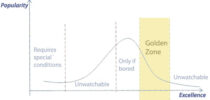
Then late at night, well after they’d cleaned up Lateline Business set, the bigger idea thudded into my mind. The real reason I love the Brownlow is that it’s boring. Then I thought back to other monumentally boring things on TV, and realised that the more producers start messing around with their perfectly working show to make it less boring, the more the show fails.

Whether it’s the Oscars or the Logies, every awards show tries really hard not to be boring. But the very reason they hold an awards ceremony, that is, to justify lucky though irrelevant people’s lives, killing that boredom is almost impossible. Not even Baz Luhrmann, with a cast of 300 monkeys shooting firecrackers out of their arses to the tune of Hello Dolly, could do it. But we’re into the stuff they award show’s rewarding, whether it’s sports, movies or the Air Conditioning Industry’s Night of Nights, the Captain Caveman in us wants to know who will win.

At the Brownlow Medal we’re transfixed to the monotone of the AFL boss reading the votes. Because that’s all he does – after announcing that the show is “an officially sanctioned meeting of the AFL”- he just reads the votes. This is just like the incredibly long bit during the Eurovision Song Contest when all the countries read their votes. But Eurovision has 25 representatives reading for a minute or two. The Brownlow just has one balding bloke, reading the names of vote winners in each of the season’s 194 games.

But to an obsessed football fan stricken with Finals Fever, this is all we want. We think back to Round 17 and wonder how Chris Judd could get votes in a losing side. This is very important to us.

Notice all the things we really hate about The Brownlow? The hideously sexist “This-is-really-the-girls’-Grand-Final” Blue Carpet bullshit. Voice over guys reciting ridiculous chest beating amateurish bush poetry over endless super-slo-mo action montages. These are things the producers reckon will break the supposed boredom of a balding man reading votes. But they don’t get it. These (marketing-tards call them..) “features” are just tedious. And yes, there is a difference.

Let’s look at Big Brother. I think it was the first series that had a daily up late show where the cameras would just sit in on a bedroom for hours into the early morning. If you watched hard and long enough, you could be lucky or unlucky to catch a hellish cat fight or a housemate having a toss under the covers. But most of the time, the household was asleep. Things happened. Very slowly.

This was genius to the power of Eno. Turning on the TV to see that nothing’s happening on TV. Man…dude….professor…that’s art. But once Mike Goldman came in with his cynical 1800 number word games and tooth-brain talkback interaction to make it less boring, the show got tedious and died. The less said about Hot Dogs, the better.

What I’m probably trying to ask people making these things on TV is, please let your story breathe. There’s no need to chuck brainless shit in just because you think you’re losing your audience. With the new ways we’re watching TV now, as talked a lot about in the podcast lately, you’re already losing your audience to a growing number of shiny lounge room distractions. Be confident. You’ll hold our attention if the story’s strong. It’s okay, real footy fans are losing their minds, waiting for round 22’s votes.  Maybe think of making captivating TV as slow cooking. Is there anything better than when the meat falls off the bone?

Cue monkey firecracker montage.

When One Wedding Is Too Many

Last week I stared into the depths of human inanity and saw what I can only assume was propagandist displays promoting misogyny.

Yes, I watched Four Weddings. Actually, to be correct, I watched it twice. Once was the UK version on a channel I barely knew existed: Lifestyle You. The other was the Australian version on Channel 7.

The premise is to take four of the whingiest, most self-centred and borderline pathological brides-to-be available and send them to each other’s weddings to judge and score them.

At the end of the show, the bride with the highest score wins a trip to the cheapest international destination without a current civil war (or an annulment to equal or lesser value).

If you’re thinking: Hang on, is this really a show in which four women get to judge each other’s celebration of love and commitment, taking something personal, making it public and then metaphorically beating it until it metaphorically bleeds all over the hired, starched, linen chair covers? You’re right.

I’ve always had a problem with the concept of “Reality Television”. It’s always been either documentary or game show to me. Reality has nothing to do with it. Four Weddings, for all its glimpses into other people’s wedding receptions, is just a very boring and low-stakes game show. The only attempt at entertainment value comes from how horrible any of the women can be about other women’s dreams.

Men are either forgotten in the entire process or made to look like useless appendages who have added nothing to the concept of the celebration. So maybe it’s not just misogyny. Maybe it’s an exercise in full-blown misanthropy.

Nobody leaves Four Weddings with their dignity. As soon as people opened their personal dreams to the concept of performance and competition, they sold the specialness of their day and will need to wear that as a memory of their lives together for as long as that lasts.

Forget Wipeout. Four Weddings is the show that brings us closer to Stephen King’s Running Man than ever before. It’s not car crash TV. It’s the mass-slaughter of societal decency.

Is that too dramatic?

One of the most annoying things about living in a sharehouse was trying to sit through the television news with my tedious housemates. How much fun it was to hear their very considered commentary about “the media this, the conspiracy that, I was reading in Pilger’s blah blah the other day…” Manufacturing consent? Here’s some consent. It’s Monday. I’ll let you take this $4.50 and go watch that Polish agridrama at the Nova. I need quiet couch time to watch Married With Children*.

Years later, and the Smug People of the Land Of Smug and their idiot cousins have broken into my lounge room through their twitter accounts.

Continue reading “The Pointlessness of Tweeting at the TV.” »

TV in HD, Please

I want my. I want my TV in HD please.

How good was that French bike race? Cadel Evans, an introvert, so insular that he loves his team members because they leave him alone, only to speak to him if it’s ‘work related’, put his head down and won the three week European torture orgy. It was a win for the quiet nerd who’s happy to go the knuckle if you walk too close. Don’t believe me? Look up “angry Cadel” on youtube.

And when it comes to three week European torture orgies, the Tour de France is by far the prettiest. On my big fat and thin LED television (yeah, I’m proud to be an effluent suburban boy with his suburban toys and if you got a problem with that, I’m happy to arrange an after-school appointment outside the Glen Waverley station, knives optional), the French countryside is so gorgeous it makes me want to weep.

But it doesn’t. It only makes me angry.

Why? Because, right now, the Tour De France is the only sporting event broadcast in high definition on free to air television. Channel Ten dropped their One HD broadcasts of the footy when they lost the bidding war, Channel Seven uses their HD capacity for Hogan’s Heroes reruns and the ABC’s VFL and lawn bowl coverage is shot on Super 8.

I was at the MCG a couple weeks ago with mates, watching another game on one of the TVs in a bar at half time. Seven’s standard definition telecast was embarrassing: So pixellated you’d think we were watching the game on a Super Nintendo. One of my mates started hitting the TV thinking it was the reception, leaving me to explain to the security guard that the beer all over the screen was Kerry Stokes’s fault. This time, we were lucky. The security guard was similarly angry at the horribly pixellated coverage of a recent Rajasthan Royals cricket game. In the end we had to pull him back from, Michael Douglas Falling Down style, smashing all the TVs in the place.

We know why the channels serve us this pixellated rubbish. It’s because they prefer to use their share of a limited amount of spectrum/signal on more programming, looking to get a snare of the audience that doesn’t like footy with Hogan’s Heroes reruns, or in the ABC’s case, News 24. The Green Guide’s Paul Kalina explains why so much better than I can.

What’s interesting in Kalina’s article is the differing in opinions between ABC’s Kim Dalton who thinks the difference in broadcast quality is marginal and Foxtel’s Patrick Delany who told Kalina that 80% of new customers sign up to their HD service, so much so that they’ve stopped ordering SD set top boxes from their supplier. And they’re listening to their big television owning sports fan audience with many HD channels and a promise to play all games of AFL next year in HD.

And what annoys me most is the emptiness behind the bragging that has always come with sports broadcasting. Race Cam, Hawk Eye, Super Tedious Slo Mo, that ridiculous camera that buzzes above the players during an AFL finals game and 3D – none of us really care.

If you really care about your audience, open up your pocket, hire some HD cameras (last year’s Grand Final replay was shot in SD because all the cameras were double booked for the Commonwealth Games), and broadcast the game in HD. It’s not too much to ask.

I’ll leave you with a bit from an amusing article from 2007 proclaiming the exciting new era of HD TV.

“Besides spectacular vistas and shockingly real playing fields, hi-def clarity puts any and all wrinkles, pimples and pores on display in well-lit bathroom-mirror detail.”

Hogaaaaan!

Supernatural (2005 – current)

Two brothers wage a war on evil, fuelled by their loved ones taken from them prematurely and the legacy left to them by their father.

Wow. So dramatic? Already? On the one hand, that really is Supernatural in a nutshell. It is an ultimate battle against demons, wraiths, succubi, ghosts and, yes, the occasional vampire. It is what I like to call “conflict with a capital K (for Killing)”. It is pure drama.

With all those other-worldly baddies, though, it’s also a perfect opportunity for some nail-biting, pillow-clutching horror. Very rarely have we had a chance to see good horror on television. There have been attempts but, really, since the early demise of American Gothic in 1996, nothing has come close.

So we’ve got the drama and we’ve got the scares. There’s a rule of three in storytelling and the third thing here is comedy. The comedy is mild, wry and sometimes relies on knowledge of the characters and their history. That’s not a bad thing. Instead of the comedy being a draw card to the series, it’s more like a prize for long-term viewers.

There is so much to love in Supernatural, it’s hard to imagine why it’s not one of the more popular shows on TV. While it’s a great show to watch, it’s possibly a hard show to sell. It doesn’t have the novelty factor of something like Buffy the Vampire Slayer and Channel 7 kept spinning that around the schedule until it found a home amongst the insomniac university students who kept it alive in a late-night slot.

1970s and 80s heavy-metal ballads, muscle cars, leather jackets and scowling faces on the backdrop of the American mid-west does not really make for appealing teaser production from an Australian point of view. It’s not about police and it’s not about lawyers or set in a hospital. In fact, on a surface level it’s not about anything that a new audience can identify with.

What it is about, though, is good old-fashioned horror, action and thrills. It’s a comic book on the screen. Heroes save people in peril and sometimes get into peril themselves. In that sense it’s predictable. But so what? Every now and then we need a little escapism. We need adventure and we need good guys kicking bad guys’ arses. Supernatural gives us that but with a style and sense of Americana unlike anything we’ve seen.

Supernatural started the year after Lost and the year before Heroes. It really should appeal to audiences of both and especially those who loved the former but found the latter lacking in any substance. Unlike Heroes, it tells a big story by focusing on a small portion of it. It builds suspense rather than forcing mystery and disseminates information as required rather than creating artificial and soulless reveals.

Mostly, though, it’s fun and intelligent entertainment. Supernatural is exactly the kind of escapism we should be inviting into our homes.

Supernatural Season 4, is available on DVD. You can find all your entertainment needs: DVDs, Blu Ray and gaming consoles, including Playstation games, at Sanity Entertainment. —Sponsoring Boxcutters

Survivors (1975 – 1977)

seymour-in-survivors.jpgThe recent decision by the BBC to revive Terry Nation’s 1970s dystopian series Survivors probably wasn’t that much of a surprise. In the wake of the hugely successful Doctor Who (and copious spin-offs), we’ve seen the return of Quatermass, Captain Scarlet and Day Of The Triffids. There’s even endless rumours (or threats) of a rebooted Blake’s 7.

The 2008 version of Survivors started off as a lesser-populated EastEnders before descending into sub-Lost territory, and was finally put out of its misery at the end of the second season (which ended – optimistically – with a cliff hanger). The best word to describe the show was “workmanlike”, combining all the usual elements of 21st Century genre telly in all the usual ways.

That’s not how you’d describe the original. Debuting in 1975, it remains the bleakest programme ever to be a prime-time hit. A man-made virus sweeps the earth, killing the majority of the population. Faced with disease, wild animals, starvation and loneliness, the few who are left struggle to survive. It’s hard to imagine showing that one against Masterchef today. Survivors, however, was a hit in the UK and across Europe, and watching it on DVD now it’s hard to imagine anyone having the guts to make such unrelenting fare now.

Part of the success is due to Terry Nation cleverly playing against type – two of the three leads are female, and Abby Grant’s search for her son forms a rock-solid premise that other story lines can weave around. Carolyn Seymour as Abby is superb, playing the part with a stoic determination you wouldn’t see on telly today. Lucy Fleming plays plucky Jenny Richards (the only totally likeable character) and Ian McCollough plays granite-faced tough guy Greg Preston. The first series raises difficult questions about the life ahead and society they will need to build, and the episode “Law And Order” still packs a punch, an unrelenting tragedy combining rape, murder and the failure of justice.

Sadly the show goes off the rails after the first season, getting bogged down (literally) with the minutiae of subsistence farming, muddled storylines and continued (and seemingly random) changes of cast. Most shamefully, Jenny Richards gets relegated to background “wife-and-mother” character and Abby Grant vanishes altogether (Seymour claims she was fired for being argumentative and drinking too much, so she moved to the US and played villains for the next 20 years. She’s particularly good as Dean Stockwell’s evil counterpart in two episodes of Quantum Leap).

All three seasons of Survivors are now available as a 39-episode box set and are worth a look, if only to see a time when television was made without focus groups or the bourgeois concept of audience appeal. The lack of incidental music, the grimy look, the strong female characters and the powerhouse credit sequence all form a convincing world that make for a fascinating visit. You do have to allow for the cheap video look and cod-Shakespearean delivery that was de rigueur for the times, but even these add a certain quality to this barren world.

A final word on the recent remake – in a bizarre piece of legal jiggery-pokery the 2008 series claimed to be “based on the novel by Terry Nation”. That “novel” was actually a novelisation of the 1975 series published a year after it went to air. Yet Adrian Hodges still had the gall to claim a “created by” credit. Shame, Adrian, shame.

Find TV series, DVDs and Blu Ray discs, including the complete Survivors Series at Sanity Entertainment.

Bloodshed, horror and sensationalism

This afternoon Channel 9 announced a new show starting this Sunday. Not sure if they were planning this before Carl Williams was killed but it’s definitely related to their Carl Williams: Baby Faced Killer show from earlier this week.

It’s possible that they discovered how quickly they can put this kind of material together and have some solid gold ratings filler by just throwing together some old news footage and shoving Vince Colosimo in a sound booth for a few hours to read a few lines of voiceover.

Called Australian Families of Crime, the whole exercise feels like a cynical attempt to plug in to an audience’s basest interests. What once seemed like the sensational and exploitative homeland of Channel 10, with their Cops / Hard Copy programming is now wholly occupied by Channel 9.

The flag they plant to claim this land as their own is in the titles of the episodes. The first is called Milat: Backpacker Bloodshed. Shocking, isn’t it.

There is, in our culture, a fascination with the macabre. I love stories of serial killers and other true crime when they’re told well. The producers of Crime Investigations Australia, credited with creating this series, have told some great stories of Australian serial killers and other criminals. They have never, however, shied away from an exploitative production style.

It’s the speed with which this series was announced and slammed onto the air (announced on Thursday and airing on Sunday) that stinks of exploitation. Capitalising on criminal behaviour is a very tight rope to walk. What makes the Underbelly series an acceptable pulp story but Baby Faced Killer a soul-less profiteering on somebody’s horrible crimes and gruesome death? Maybe it’s just time but then the adage states that timing is everything.

Australian Families of Crime airs at 9:30pm Sunday on Channel 9.